Description
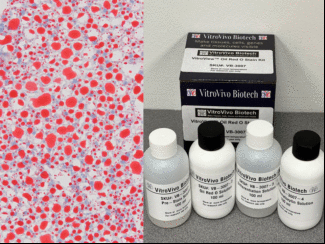
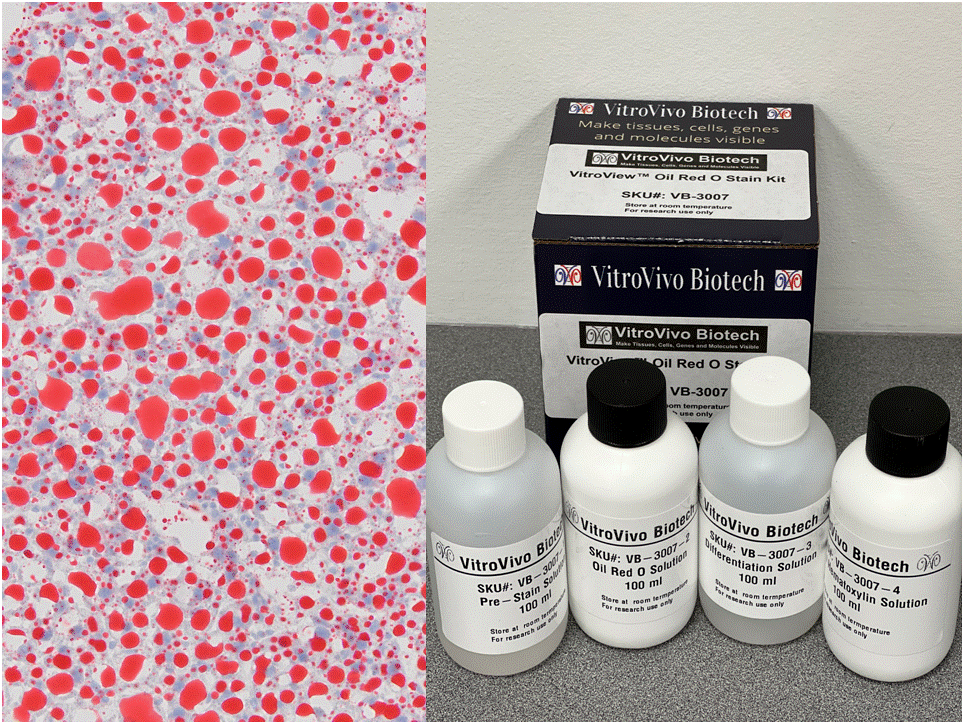
Oil Red O is a lysochrome diazo dye used for detecting neutral triglycerides and lipids in tissue. It is performed on fresh frozen tissue sections or cultured cells. Oil Red O Stain Kit is used for lipid and fat staining on formalin fixed frozen sections. It is not suitable for paraffin embedded tissue sections.
VitroView™ Oil Red O Stain Kit and Protocol Video
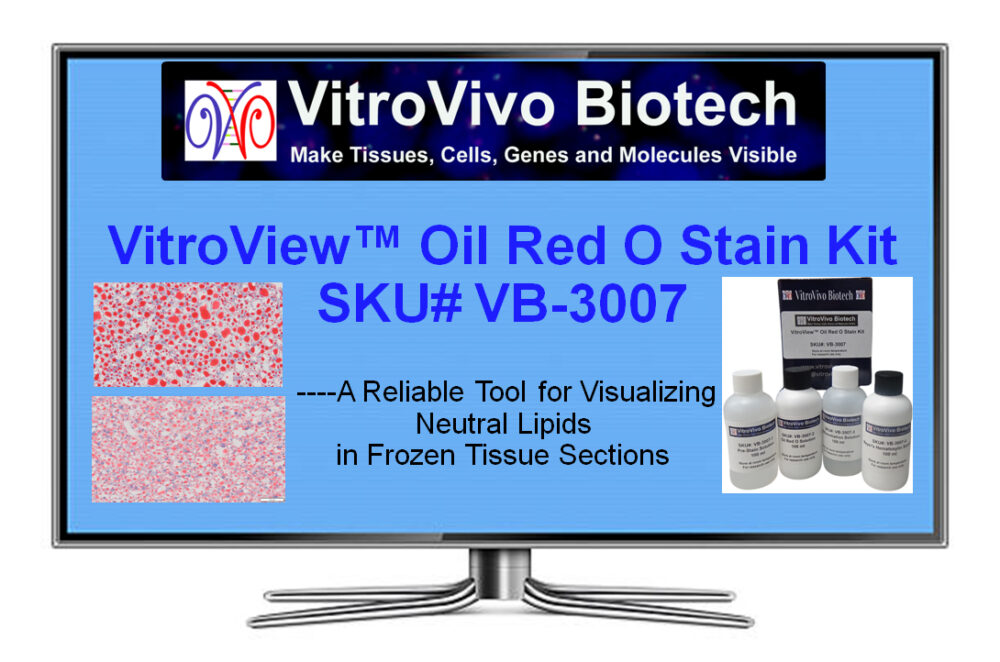
Kit Contents
- VB-3007-1 Pre-Stain Solution ———————– 100 ml
- VB-3007-2 Oil Red O Solution ————————100 ml
- VB-3007-3 Differentiation Solution————— 100 ml
- VB-3007-4 Mayer’s Hematoxylin Solution —- 100 ml
Storage
Room temperature.
Protocol
- Cut frozen sections to 8 to10μm. Air dry the sections to the slides
- Fix in 10% buffered formalin for 20 mins at room temperature, briefly wash with running tap water for 3 mins.
- Place in Pre-Stain Solution for 2 mins
- Stain in pre-warmed Oil Red O solution for 10 minutes at room temperature
- Differentiate in Differentiation Solution for 5 minutes at room temperature
- Rinse in 2 water changes of distilled at room temperature.
- Lightly stain nuclei with Mayer’s Hematoxylin Solution for 1 minute.
- Rinse with tap water for 3 mins
- Mount with aqueous mounting medium.
Technical Points
- Include a positive control
- Cryostat sections 8 to 10 microns for formalin fixed smears. Formalin fixation gives good results.
- Step 9 – Obviously, the section must not be taken through clearing solvents prior to mounting, as this will remove the lipid to be detected.
Results
- Lipid…………………………….. red
- Nuclei…………………………….blue
More Oil Red Staining Images
|
|
|
|
|
|
|
|
|


Note: This product is intended for research purposes only. This product is not intended to be used for therapeutic or diagnostic purposes in humans or animals.
Precautions: Handle with care. Avoid contact with eyes, skin and clothing. Do not ingest. Wear gloves.
User Manual and Material Safety Data Sheet (MSDS) (PDF)
Frequently Asked Questions
What does this kit stain?
Oil Red O is a lysochrome diazo dye used for detecting neutral triglycerides and lipids in tissue. Lipids stain red and nuclei stain blue.
What sample types can I use it on?
Fresh frozen tissue sections or cultured cells. The kit is used for lipid and fat staining on formalin-fixed frozen sections. It is not suitable for paraffin-embedded tissue sections.
What is included in the kit?
Four ready-to-use solutions, 100 ml each: Pre-Stain Solution (VB-3007-1), Oil Red O Solution (VB-3007-2), Differentiation Solution (VB-3007-3), and Mayer’s Hematoxylin Solution (VB-3007-4).
How should I store the kit?
At room temperature.
How does the staining protocol work?
Cut frozen sections to 8–10 µm, air dry them onto slides, and fix in 10% buffered formalin for 20 minutes at room temperature. Place sections in Pre-Stain Solution for 2 minutes, stain in pre-warmed Oil Red O solution for 10 minutes, differentiate for 5 minutes, then lightly stain nuclei with Mayer’s Hematoxylin Solution for 1 minute and mount with an aqueous mounting medium. A protocol video is linked on the product page. Include a positive control, and do not take sections through clearing solvents before mounting, as this will remove the lipid being detected.
How do I order this kit, and is it for diagnostic use?
The kit is available from vitrovivo.com (listed as in stock) and can also be ordered by email at orders@vitrovivo.com or by phone at 301-500-0499. It is intended for research purposes only and is not intended for therapeutic or diagnostic use in humans or animals.