Description
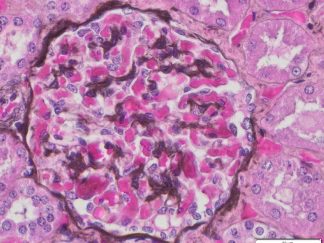
The dialdehydes formed by treatment with periodic acid from certain carbohydrates, will selectively reduce an alkaline hexamine-silver salt mixture. This kit is especially suitable for renal glomerular basement membranes. It is very helpful to determine the thickness of glomerular basement membranes and mesangial matrix.
Kit Components
| Sku# | Reagent Name | Volume (ml) |
| VB-3033-1 | Periodic acid 1% | 100 ml |
| VB-3033-2 | Silver nitrate 5% | 35 ml |
| VB-3033-3 | Methenamine 3% | 35 ml |
| VB-3033-4 | Sodium tetraborate 2% | 35 ml |
| VB-3033-5 | Gold chloride 0.25% | 100 ml |
| VB-3033-6 | Sodium thiosulfate 5% | 100ml |
| VB-3033-7 | Mayer’s hematoxylin solution | 100 ml |
| VB-3033-8 | Eosin solution | 100 ml |
Storage
Store Silver Nitrate 5% and Gold chloride 0.25% at 2-8 °C. The other components can be stored at room temperature.
Protocol
- Deparaffinize in xylene I for 6 minutes and II for 6 minutes. Rehydrate:
- Ethanol 100% (2 minutes)×2
- Ethanol 95% (2 minutes)×2
- Ethanol 70% (2 minutes)×1
- Rinse in DI water (2 minutes)×1
- Incubate the sections with Periodic acid 1% for 30 minutes.
- Wash in distilled water.
- Fresh make silver methenamine solution: Mix Silver nitrate 5% , Methenamine 3% and Sodium tetraborate 2% at a ratio of 1:1:1.
- Incubate the section with silver methenamine solution in oven for 30 minutes at 60°C. Check the slide microscopically after 20 minutes then every 5 minutes until the basement membrane is well demonstrated. If necessary, incubate again. The sections should turn tobacco.
- Wash in hot distilled water (60°C) for 4 min. Wash in room temperature distilled water for 1 min.
- Incubate the section with Gold chloride 0.25% for 1 minute.
- Wash in distilled water.
- Incubate the section with Sodium thiosulfate 5% for 1 minute.
- Wash in distilled water.
- Stain the sections with hematoxylin for 2 min.
- Running tap water for 2 min.
- Stain the sections with Eosin for 1min.
- Dehydrate with 2 changes of 100% Ethanol (2 minute per change).
- Clear with 2 changes of xylene (5 minute per change).
- Mount cover slip onto glass slide with VitroView™ Permanent Mounting Medium (VB-8003) or some other suitable organic mounting medium.
Control Tissue: Kidney section
Expected Results:
- Basement membranes …………………………….Black
- Cell Nuclear…………………………………………Blue
- Background ………………………………………..Pink/Red
References:
- Ohga S, et al (2007) . Thiazolidinedione ameliorates renal injury in experimental diabetic rats through anti-inflammatory effects mediated by inhibition of NF-kappaB activation. American journal of physiology. Renal physiology 292(4):F1141-50.
- Francis A, at al.(2016). Polypoid Change of the Glomerular Basement Membrane in a Child with Steroid Resistant Nephrotic Syndrome and ARHGAP24 Mutation: A Case Report. The Open Urology & Nephrology Journal 9(1):88-93
Note:
This product is intended for research purposes only. This product is not intended to be used for therapeutic or diagnostic purposes in humans or animals.
Precautions:
Handle with care. Avoid contact with eyes, skin and clothing. Do not ingest. Wear gloves.
More Images
 |
 |
 |
User Manual and Material Safety Data Sheet (MSDS) (PDF)
Frequently Asked Questions
What is this kit used for?
Demonstrating renal glomerular basement membranes. Dialdehydes formed by periodic acid treatment of certain carbohydrates selectively reduce an alkaline hexamine-silver salt mixture, making the kit especially suitable for determining the thickness of glomerular basement membranes and mesangial matrix. Basement membranes stain black, cell nuclei blue, and the background pink/red.
What sample types can I use it on?
The protocol on the product page is written for paraffin sections (deparaffinize in xylene, then rehydrate through graded ethanols). Suggested control tissue is kidney section.
What is in the kit?
Periodic Acid 1% (100 ml), Silver Nitrate 5% (35 ml), Methenamine 3% (35 ml), Sodium Tetraborate 2% (35 ml), Gold Chloride 0.25% (100 ml), Sodium Thiosulfate 5% (100 ml), Mayer’s Hematoxylin Solution (100 ml), and Eosin Solution (100 ml).
How do I store it?
Store the Silver Nitrate 5% and Gold Chloride 0.25% at 2–8 °C; all other components can be stored at room temperature.
Is there anything I need to prepare before starting?
Yes. The silver methenamine solution must be made fresh by mixing Silver Nitrate 5%, Methenamine 3% and Sodium Tetraborate 2% at a 1:1:1 ratio, and sections are incubated in it in an oven at 60 °C for 30 minutes, checking microscopically after 20 minutes and then every 5 minutes until the basement membrane is well demonstrated.
Is this kit for diagnostic use?
No. It is intended for research purposes only, and is not intended for therapeutic or diagnostic use in humans or animals.