Description
The VitroSure™ RNA Isolation Kit for Frozen and Fresh Cells and Tissues is a ready-to-use (RTU) kit designed for the efficient isolation of high-quality total RNA from frozen and fresh cell and tissue samples. The kit is optimized for reproducible performance and uses a well-established silica-based spin-column technology that selectively binds RNA while effectively removing proteins, genomic DNA, and other cellular contaminants.
The streamlined purification workflow supports rapid sample processing and consistently delivers RNA with high purity and integrity, suitable for a broad range of downstream molecular biology applications, including reverse transcription, quantitative PCR (qPCR), and next-generation sequencing (NGS). The VitroSure™ RNA Isolation Kit provides a reliable solution for laboratories requiring robust RNA purification from diverse biological sample types.
Technical Specifications
| Equipment needed | Microcentrifuge, Homogenizer |
| RNA Type Isolated | Total RNA |
| Yield | Up to 50 µg total RNA |
| Purity | Typical A260/A280 ≥ 1.8 |
| Eluted RNA Storage | at ≤ -20°C |
| Sample Source | Frozen, Fresh Cells and Tissues |
| Processing Capacity | 100 cells-1×10⁷ cells; or ≤30 mg of mammalian tissue |
| Applicable For | RNA-Seq, qRT-PCR, Northern Blotting, and Microarray analysis, etc. |
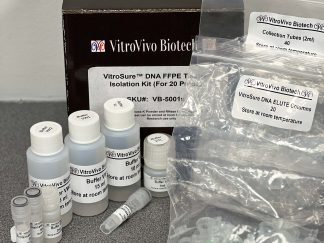
Kit Contents
| Buffer VLT | 15 ml |
| Buffer VRW1 | 20 ml |
| Buffer VPE | 15 ml |
| RNase-Free Water | 1.5 ml |
| VitroSure RNA Elute Columns | 20 |
| Collection Tubes (2 ml) | 40 |
Storage
- Store at room temperature.
Procedures
- Sample Preparation:
For fresh, frozen cells
For cultured cells (Recommended from cell culture no more than 1 × 10⁷ cells)
1) Cells grown in suspension culture:
- Determine the number of cells and pellet the cells by centrifuging for 5 min at 300×g in a centrifuge tube.
- Carefully remove all supernatant by aspiration and proceed to purification step 2.
2) Cells grown in adherent culture:
- Determine the number of cells and aspirate the medium.
- Wash the cells with PBS and aspirate the PBS.
- Add 0.1–0.25% trypsin in PBS.
- After the cells detached from the dish or flask, add medium, transfer the cells to an
- RNase-free glass or polypropylene centrifuge tube.
- Centrifuge at 300×g for 5 min.
- Completely aspirate the supernatant and proceed to purification step 2.
3) For blood cells (Recommended from leukocyte cells from 5 x 10⁶/ml to 1 x 10⁷/ml)
- Pellet the cells by centrifugation at 1000 x g for 15 min.
- Resuspend the sample in 1 ml of PBS.
- Completely aspirate the supernatant and proceed to purification step 2.
- If the sample is frozen cells, thaw the cells and spin them down. Completely aspirate the supernatant and proceed to purification step 2.
For mammalian tissue
- Place the following amount of mammalian tissue or tail directly into a suitably sized vessel for disruption and homogenization:
- ≤30 mg of minced mammalian tissue
- ≤10 mg minced spleen tissue
- 1 cm mouse or 0.5 cm rat tail clip
- Proceed to purification step 2.
- Resuspend the pellets or tissue in 600 µl Buffer VLT and homogenize the lysate with a suitable homogenizer for 2 minutes. Note: Add 10 µl β-ME per 1 ml Buffer VLT before use.
- Add 1 volume of 70% ethanol to the homogenized lysate and mix well by pipetting.
- Transfer all the lysate to an RNA Elute column and centrifuge at 8000×g (or 10000 rpm) for 1 minute. Discard the flow-through.
- Add 350 µl Buffer VRW1 to the column and centrifuge at 8000×g (or 10000 rpm) for 1 minute. Discard the flow-through.
- Eliminating genomic DNA contamination (Option): DNase digestion is generally not required, as silica-membrane technology efficiently removes most genomic DNA. However, for applications highly sensitive to trace DNA contamination, an additional DNase treatment with DNase Set (SKU# VB-5007, sold separately) is recommended.
- For the preparation of DNase I stock solution, add 550 μl of RNase-Free Water to 1 mg of DNase I powder, and gently mix by inverting the vial. After reconstitution, aliquot the DNase I solutions, then store them at -20°C. Please refrain from subjecting the solutions to repeated thaw-and-melt cycles to maintain their stability.
- Add 10 µl DNase I stock solution to 70 µl Buffer VDD. Mix by gently inverting the tube.
- Add the above DNase I solution directly to the column membrane and incubate at RT (20–30°C) for 15 min.
- Add 350 µl Buffer VRW1 to the column and centrifuge at 8000×g (or 10000 rpm) for 1 minute. Discard the flow-through.
- Add 500 µl Buffer VPE to the column and centrifuge at 8000×g (or 10000 rpm) for 1 minute. Discard the flow-through. Repeat this step.
- Place the column in a clean 2 ml collection tube. Centrifuge at maximum speed for 3 minutes with the lid open to completely dry the membrane.
- Place the column in a new 1.5 ml collection tube and add 30-50 µl RNase-free water directly to the column membrane. Incubate at room temperature for 1 min, then centrifuge at maximum speed for 1 min to elute the RNA.
User Manual and Material Safety Data Sheet (MSDS) (PDF )
VB-5005 MSDS
Note
This product is intended for research purposes only. This product is not intended to be used for therapeutic or diagnostic purposes in humans or animals.
Precautions
Handle with care. Avoid contact with eyes, skin and clothing. Do not ingest. Wear gloves.