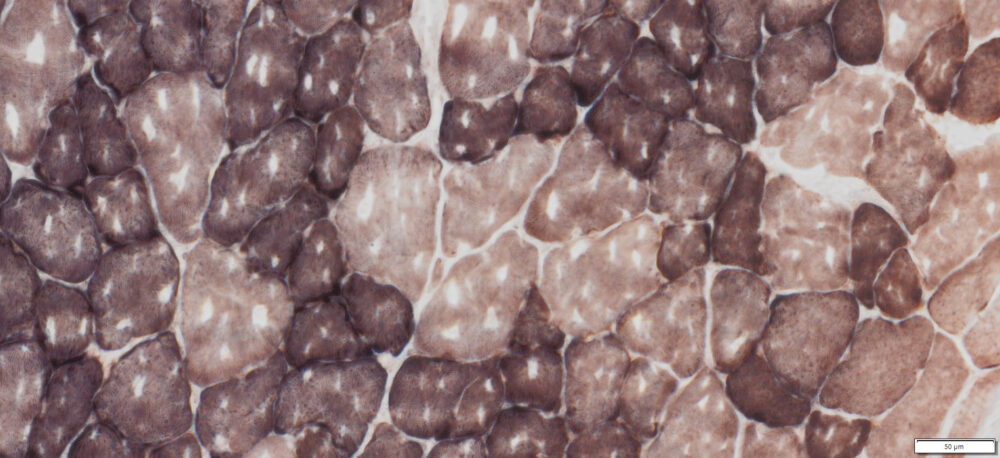
Observing respiratory enzyme activity provides a straightforward method for investigating mitochondrial dysfunction. Cytochrome c oxidase (COX) is crucial for mitochondrial function, while succinate dehydrogenase (SDH) is entirely encoded by nuclear DNA and remains unaffected by mitochondrial DNA (mtDNA) mutations. A combined COX/SDH stain highlights COX-negative fibers, which may appear SDH-positive and correspond to ragged red fibers. Since three of the 13 COX subunits are mtDNA-encoded, mtDNA mutations can impair COX activity, whereas SDH remains unaffected. In mitochondrial myopathies, ragged red fibers are typically COX-negative, except in Mitochondrial Encephalopathy, Lactic Acidosis, and Stroke-like Episodes (MELAS). Additionally, intra-fiber mosaicism—characterized by a mix of COX-deficient (bluish) and COX-positive (brownish) mitochondria within the same fiber—is well demonstrated with this staining technique. Mitochondrial diseases, aging, and age-related conditions often lead to cells with reduced or absent COX activity, making this method valuable for research and diagnostics.
Kit Introduction Viedeo
Kit Components
SKU#
Reagent
Size
VB-3022-1
COX A Solution
1ml×5
VB-3022-2
COX B Solution
1ml×5
VB-3022-3
Succinate Solution
0.3ml×5
VB-3022-4
Yellow SDH Incubation Medium
1.5 ml×5
VB-3022-5
COX Inhibitor Solution
1ml×2
VB-3022-6
SDH Inhibitor Solution
0.5 ml×2
Storage
Store at -20°C
Protocol
Tissue preparation for cryosectioning
Euthanize the animal using cervical dislocation or decapitation, following the approved ethical permit.
Rapidly collect tissues of interest without fixation and immediately freeze them on dry ice. For optimal morphology, tissues may require freezing in isopentane or propane chilled with liquid nitrogen.
Wrap tissues in aluminum foil and store at -80 °C until sectioning.
Embed frozen tissues in preparation for cryosectioning.
Cut 10-14 μm cryostat sections, thaw them onto slides at room temperature for 2-5 minutes, and store slides without cover-slipping at -70 °C until use.
Prepare COX Incubation Solution: Thaw one vial of COX A Solution (VB-3022-1) and one vial of COX B Solution (VB-3022-2). Mix one vial of COX A Solution with one vial of COX B Solution thoroughly.
Rinse: Wash the slides with PBS to remove any residual OCT from the glass.
Incubate with COX Solution: Immediately apply 80–200 µL of the COX incubation solution onto frozen sectioned slides in a humidity chamber. Incubate in the dark at room temperature for 1–1.5 hours.
Check Staining: Assess the staining and extend the incubation time if needed.
Rinse: Wash the slides in PBS.
Prepare Fresh SDH Incubation Medium: Thaw a 0.3 mL vial of Succinate Solution (VB-3022-3) and a 1.5 mL vial of Yellow SDH Incubation Medium (VB-3022-4). Mix 0.3 mL of Succinate Solution with 1.5 mL of Yellow SDH Incubation Medium, or combine them at a 1:5 ratio. Mix well before use.
Incubate with SDH Solution: Apply 80–200 µL of the SDH incubation medium onto the slide and incubate at 37°C for 40 minutes.
Dehydrate: Perform two changes of 95% ethanol followed by two changes of 100% ethanol, with each step lasting 2 minutes.
Clear: Immerse the slides in three changes of xylene, with each step lasting 5 minutes.
Mount Coverslip: Apply Permount or another suitable organic mounting medium and place a coverslip onto the glass slide.
Appropriate specificity controls
Specificity Control for COX Activity: Before step 3, apply 80-200 µL of COX Inhibitor Solution (VB-2022-5) to the slide. Incubate for 5 minutes, then proceed to step 3.
Specificity Control for SDH Activity: Prepare a solution by mixing SDH Inhibitor Solution (VB-3022-6) with Yellow SDH Incubation Medium (VB-3022-4) at a 1:5 ratio. Apply 80-200 µL of this mixture onto the slide, ensuring the section is covered, and incubate at 37°C for 40 minutes. This step replaces step 7.
Results
Cytochrome Oxidase positive mitochondria——-
Brown
Cytochrome Oxidase negative mitochondria——-
Blue
More Images
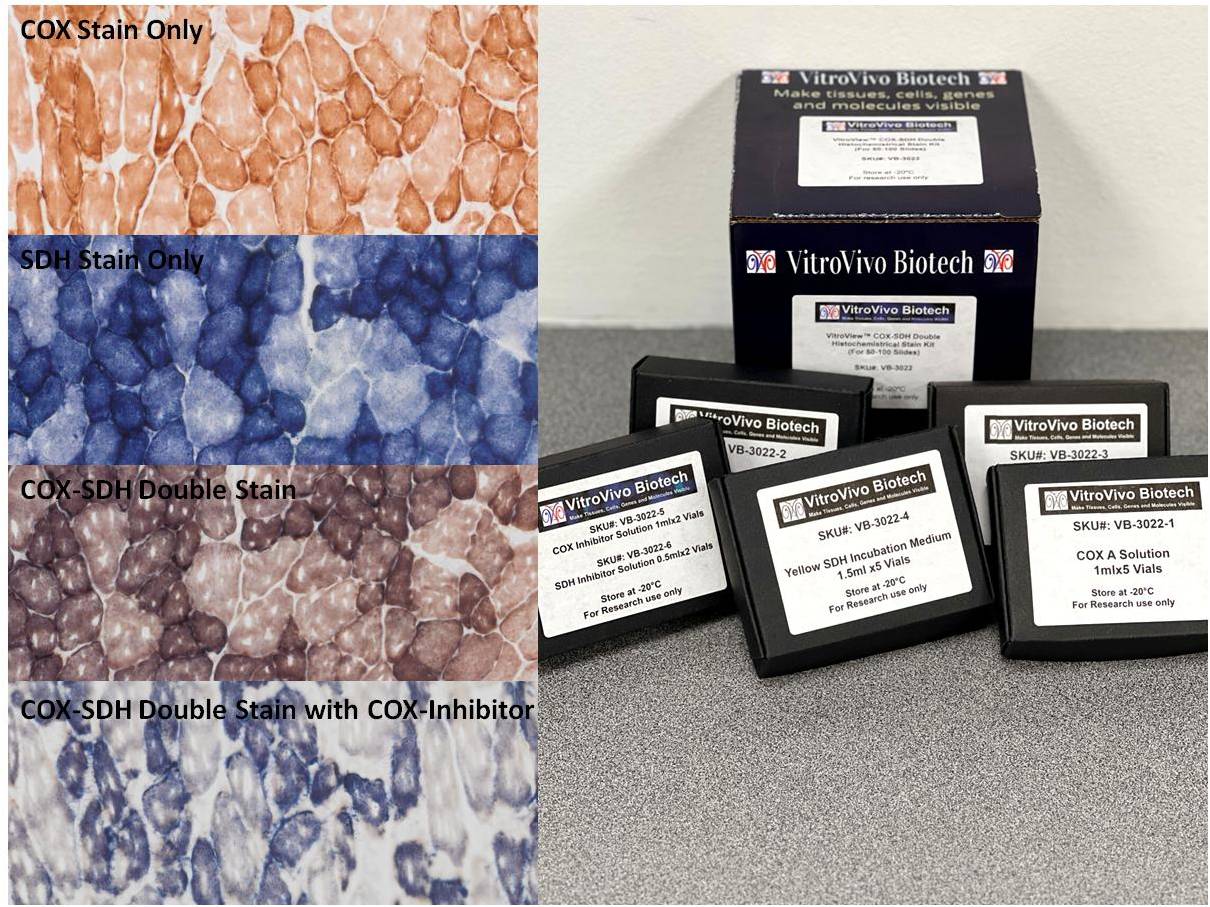
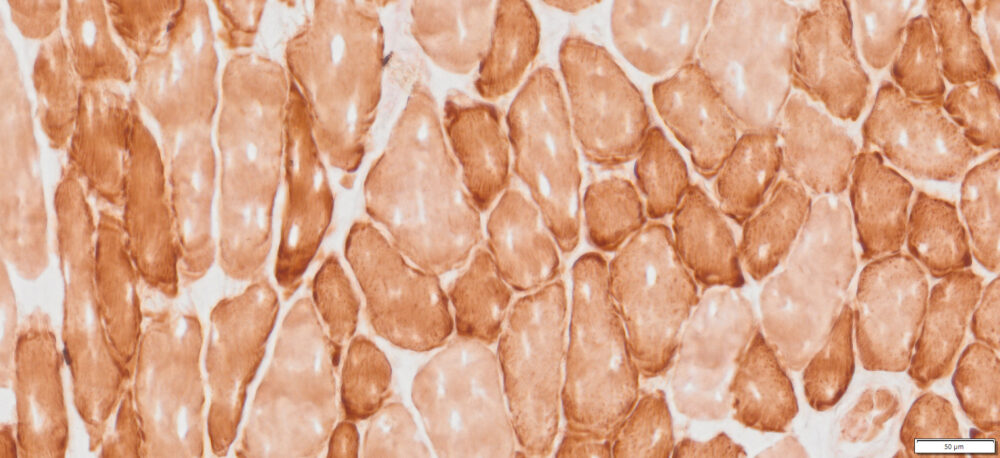
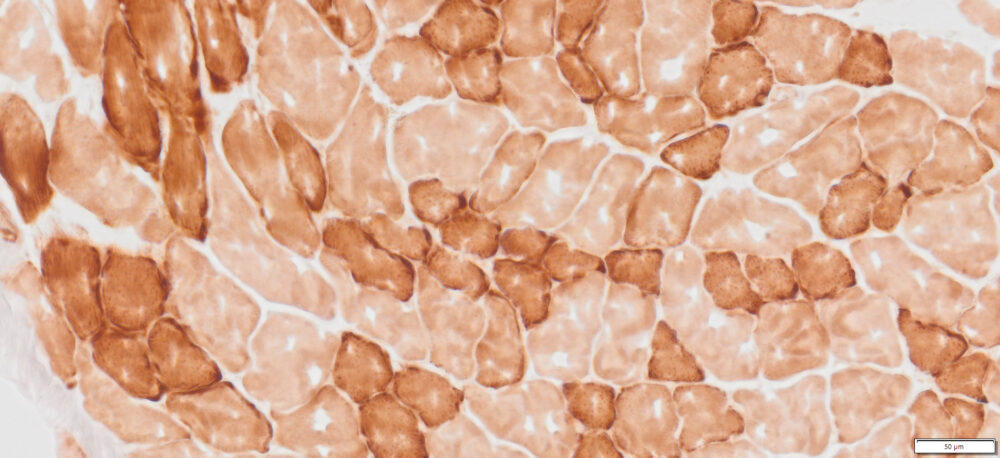
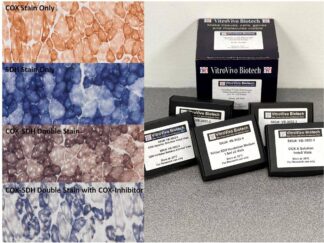
COX Stain Only on mouse muscle section, Cox stained at room temperature for 60 minutes, 20x
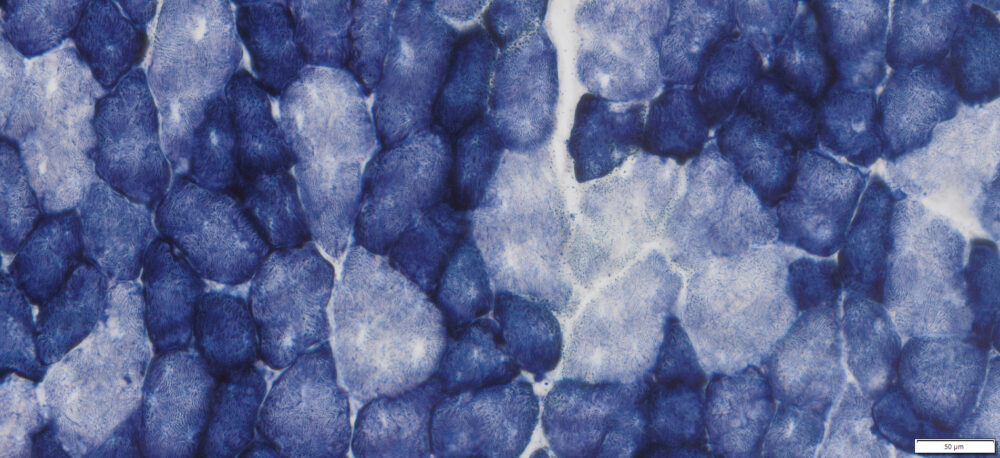
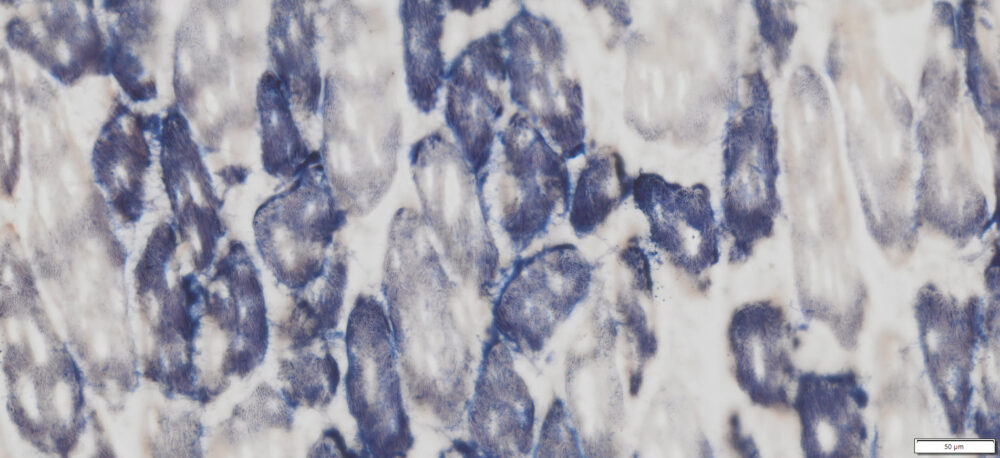
SDH Stain Only on mouse muscle section, SDH stained at 37ºC for 40 minutes, 20x
COX/SDH Double Stain on mouse muscle section, Cox stained at room temperature for 60 minutes, SDH stained at 37ºC for 40 minutes, 20x
COX/SDH Double Stain with Cox inhibitor on mouse muscle section, Cox stained at room temperature for 120 minutes, SDH stained at 37ºC for 40 minutes, 20x
COX/SDH Double Stain with SDH inhibitor on mouse muscle section, Cox stained at room temperature for 60 minutes, SDH stained at 37ºC for 40 minutes, 20x
Selected Peer-reviewed publications and preprints that have cited the use of VitroView™ COX-SDH Double Histochemistry Stain Kit (For 50-100 Slides) (VB-3022)
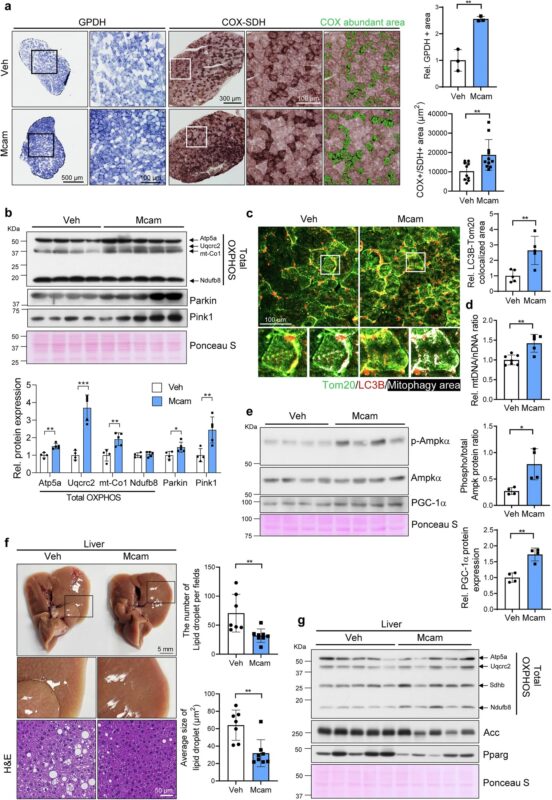
Figue Legend: a GPDH and COX-SDH enzyme activity staining in extensor digitorum longus muscles. Top right graph indicates relative GPDH staining-positive area (n = 3). Bottom right graph indicates COX/SDH-positive staining area (μm2) (Veh n = 10, Mcam n = 11). b Immunoblot analysis for indicated protein expression in GAS muscles. The bottom graph shows relative expression levels of indicated proteins (Veh n = 4, Mcam n = 5). c Immunostaining for LC3B (red) and Tom20 (green) in TA muscles. Right graph indicates relative LC3B-Tom20 colocalized area (n = 5). d Quantitative real-time PCR analysis for ratio of mtDNA/nDNA in GAS muscles (Veh n = 7, Mcam n = 6). e Immunoblot analysis for indicated protein expression in quadriceps muscles. Top right graph indicates phosphorylated Ampkα levels. Bottom right graph indicates relative protein expression levels of PGC-1α (n = 4). f The gross images of liver (top) and haematoxylin and eosin (H&E) staining (bottom) in Veh- or Mcam-treated mice. Top right graph indicates the number of lipid droplets in liver. Bottom right graph indicates average size (μm2) of lipid droplets (Veh n = 7, Mcam n = 8). g Immunoblot analysis for indicated protein expression in liver (n = 5). Data are presented as mean ± SD. Statistical significance was determined using unpaired Student’s t test. *P < 0.05, **P < 0.01 and ***P < 0.001.
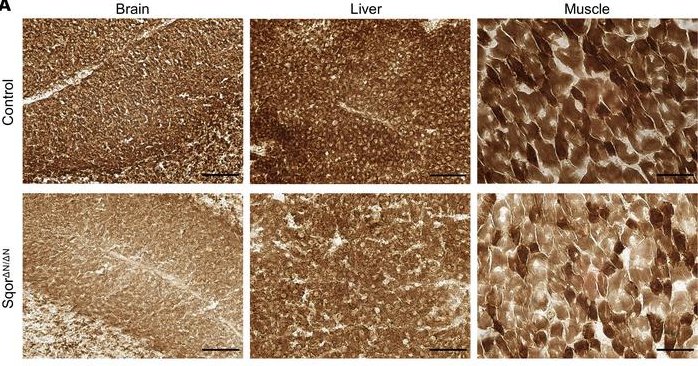
Figure 2. SqorΔN/ΔN mice had decreased complex IV activity, increased systemic H2 S levels, and an impaired metabolic status. (A) Histochemical staining was used to measure cytochrome c oxidase (COX) activity in SqorΔN/ΔN and control mice. Control mouse brain, liver, and muscle sections are stained dark brown; the same tissues from SqorΔN/ΔN mice are light brown, indicating decreased complex IV activity. Scale bars: 100 μm. (B) Complex IV activity in isolated mitochondria of the brain, liver, and muscle. The mean values of complex IV activity in control mice were set to 100%. Comparisons were made using unpaired 2-tailed t test. n = 5–6 mice for each group. Data are presented as means with SD. (C) Sulfide levels in plasma, brain, liver, and muscle were measured using HSip-1. The sulfide levels in SqorΔN/ΔN mice were compared with those in control mice (the sulfide level for control mice was set to 1). Data were analyzed using Mann-Whitney test for plasma, and unpaired 2-tailed t test for brain, liver, and muscle. n = 5–8 mice for each group. Data are presented as medians with interquartile range for plasma, and as means with SD for brain, liver, and muscle. (D) Compared with control mice, the blood lactate levels in SqorΔN/ΔN mice were higher at postnatal ages 30, 40, and 50 days. Comparisons between SqorΔN/ΔN and control mice at postnatal ages 30, 40, and 50 days were made using unpaired 2-tailed t test. Mixed-effects analysis with Dunnett’s multiple-comparison test was performed to compare the blood lactate levels at postnatal ages 30, 40, and 50 days in SqorΔN/ΔN mice. n = 4–5 mice for each group. Data are presented as means with SD.
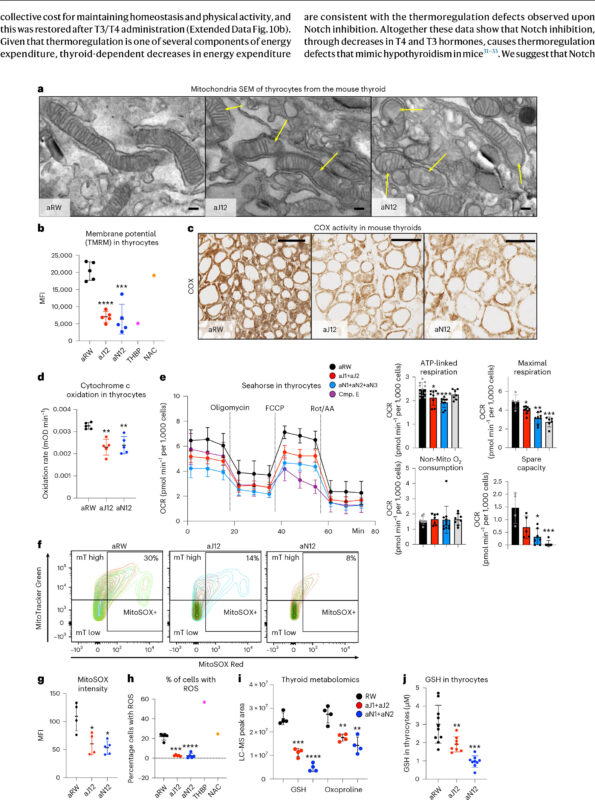
Fig. 3 Notch blockade induces mitochondrial defects in thyrocytes. a, Representative electron microscopy images of thyrocyte mitochondria from mice (n = 3) treated for 7 d with aRW (40 mg kg−1), aJ12 (20 mg kg−1 each) or aN12 (5 and 10 mg kg−1, respectively). Arrows indicate aberrant mitochondria. Scale bars,200 nm. SEM, scanning electron microscopy. b, Mean fluorescence intensity (MFI) of TMRM to measure mitochondrial membrane potential in primary thyrocytes isolated from mice (n = 5) treated as in a. In vitro treatment with TBHP (100 μM), positive control and with N-acetylcysteine (NAC, 10 mM), negative control. Mean } s.d. c, COX staining (VitroView) in thyroid cryosections from mice (n = 4) treated as in a. Scale bars, 100 μm. d, Cytochrome c oxidation rate (mOD min−1) in primary thyrocytes isolated from mice (n = 5) treated as in a. Mean } s.d. e, Cell Mito Stress Seahorse assay in FRTL5 thyrocytes cultured for 2 d with aRW (25 μg ml−1), aJ12 (25 μg ml−1 each), aN123 (25 μg ml−1 each) or Compound E (Cmp. E) (1 μM). Oligomycin inhibits ATP synthase, decreasing electron flow through the electron transport chain and the oxygen consumption rate (OCR) linked to ATP production (ATP-linked respiration). FCCP collapses the proton gradient, allowing complex IV to reach its maximum (maximal respiration). Rotenone/AA inhibit complexes I and III, respectively, shutting down mitochondrial respiration without affecting non-mitochondrial respiration. The spare capacity equals maximal minus basal respiration. Mean } s.d.; n = 5 wells. f, Fluorescent density plots following 1 h staining with MitoTracker Green (mT), which accumulates in the mitochondria, and MitoSOX Red, which reacts with superoxide (O2 −), from thyrocytes isolated from mice (n = 5) treated as in a. g, MFI of MitoSOX Red staining in f. Mean } s.d. h, Percentage of positive cells following 1 h DCFDA staining of thyrocytes isolated from mice (n = 5) treated as in a. TBHP (100 μM) and NAC (10 mM) served as controls as in b. Mean } s.d. i, Mass spectrometry measurements of the indicated metabolites in thyroids from mice (n = 4) treated as in a. Mean } s.d. j, Glutathione (GSH) concentrations in thyrocytes isolated from mice (n = 8) treated as in a and measured by fluorometry. Mean } s.d. Statistical significance was assessed using an unpaired two-tailed Student’s t-test with Welch’s correction: *P < 0.05; **P < 0.01; ***P < 0.001; ****P < 0.0001.
References
Ross, J.M. Visualization of Mitochondrial Respiratory Function using Cytochrome C Oxidase / Succinate Dehydrogenase (COX/SDH) Double-labeling Histochemistry. J. Vis. Exp. (57), e3266, DOI : 10.3791/3266 (2011).
Seligman etal (1968) J Cell Biol 38:1-14.
Loughlin M. (1993). Muscle biopsy. A laboratory investigation. Butterworth-Heinemann p.38-39.
This product is intended for research purposes only. This product is not intended to be used for therapeutic or diagnostic purposes in humans or animals.
Precautions
Handle with care. Avoid contact with eyes, skin and clothing. Do not ingest. Wear gloves.
Related products
VitroView™ Hematoxylin and Eosin Stain Kit (30 ml per Dropper bottle)
SKU: VB-3000sSale!$70.00Original price was: $70.00.$63.00Current price is: $63.00.
VitroView™ Hematoxylin and Eosin Stain Kit (500 ml per bottle)
SKU: VB-3000LSale!$171.35Original price was: $171.35.$154.21Current price is: $154.21.
VitroView™ Alcian Blue – PAS Stain Kit
SKU: VB-3005Sale!$324.50Original price was: $324.50.$292.05Current price is: $292.05.