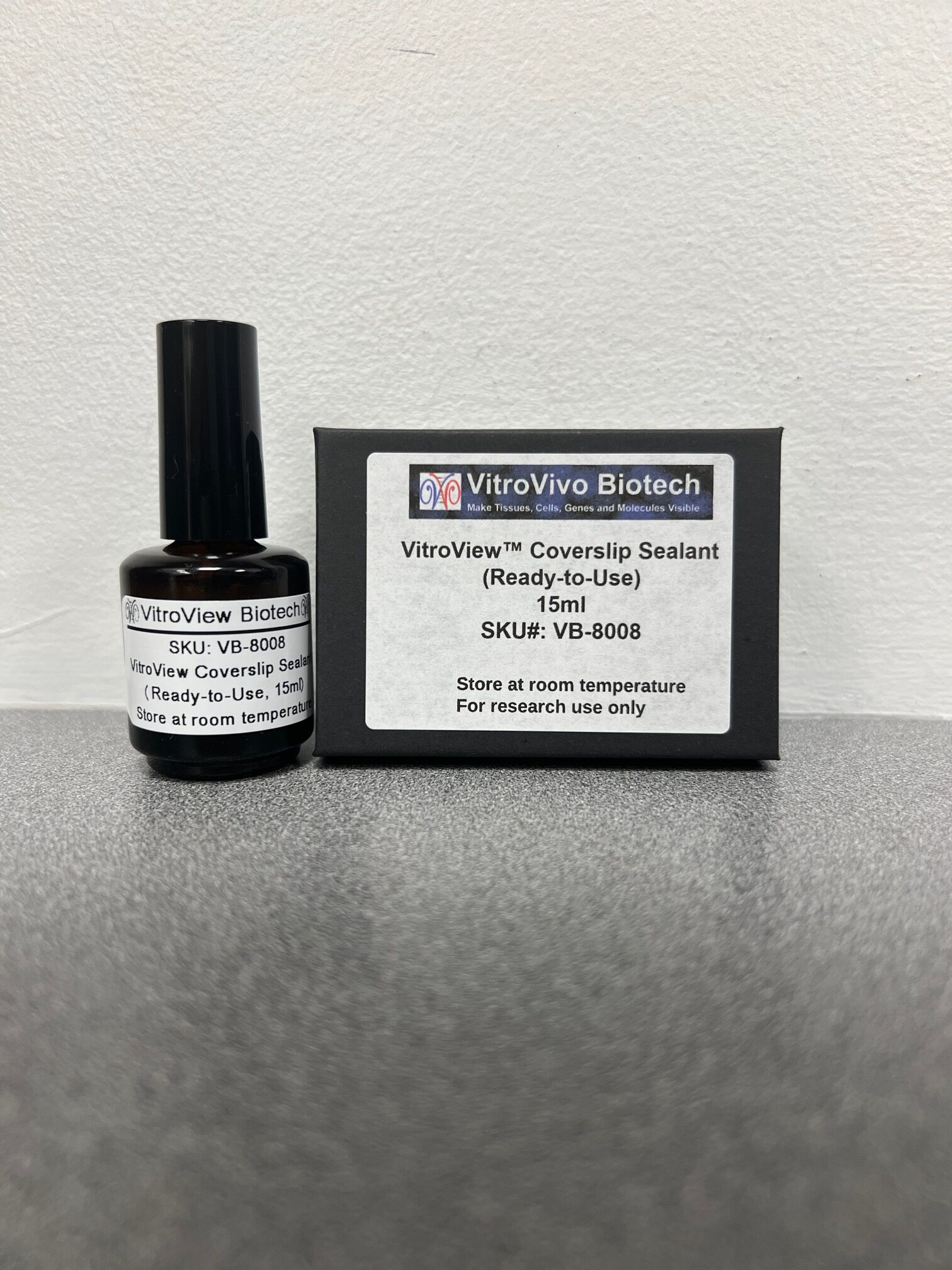
Description
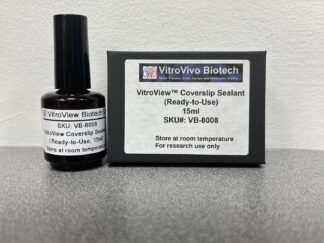
VitroView™ Coverslip Sealant is a ready-to-use sealant specifically designed to seal microscope coverslips for use with aqueous mounting media. The product is particularly useful for applications in which an aqueous mounting medium remains beneath the coverslip, including immunofluorescence (IF), fluorescence microscopy, Oil Red O staining, and other aqueous-mounted histological and cytological preparations. When applied around the perimeter of a coverslip, VitroView™ Coverslip Sealant forms a protective seal that helps secure the coverslip in place and reduce evaporation, leakage, and drying of the aqueous mounting medium.
Application
The product is designed primarily for sealing coverslips on preparations mounted with aqueous or water-based mounting media, including:
- Immunofluorescence (IF)
- Fluorescence microscopy
- Oil Red O or Sudan Black B Lipid staining
- Histochemical staining
- Frozen tissue sections
- Cytological preparations
- Other aqueous-mounted tissue or cell preparations
Advantage
- Rapid-Drying Formula: Minimizes waiting time during slide preparation.
- Low Background Fluorescence: Optimizes clarity under fluorescent imaging.
- Freeze-Thaw Stable: Prevents cracking and maintains structural integrity at -20°C.
- Dual-Brush Applicator: Includes a fine tip tailored for routine slide precision.
Package Size
15ml/ bottle with Brush-Cap
Storage
Store VitroView™ Coverslip Sealant at room temperature.
Storage recommendations
- Keep the container tightly closed.
- Store in the original container.
- Store in a cool, dry, well-ventilated area.
- Protect from direct sunlight.
- Keep away from heat, sparks, and ignition sources.
- Do not leave the container open during use.
Close the bottle promptly after application to minimize evaporation and changes in product viscosity.
Coverslip Sealing Procedure
- Step 1. Complete the Staining Procedure
- Complete the desired staining procedure according to the appropriate laboratory protocol.
- Ensure that the specimen is properly prepared for mounting.
Step 2. Apply Mounting Medium
- Apply an appropriate mounting medium to the specimen.
- Use sufficient mounting medium to cover the specimen without excessive overflow beyond the coverslip.
Step 3. Place the Coverslip
- Using fine-point forceps, carefully place a clean glass coverslip over the specimen.
- Lower the coverslip gradually to minimize formation of air bubbles.
- Allow excess mounting medium to move toward the edges of the coverslip.
Step 4. Remove Excess Mounting Medium
- If necessary, carefully remove excess mounting medium from around the outside perimeter of the coverslip using a lint-free tissue.
- Do not disturb or lift the coverslip.
- The outer edge of the coverslip should be reasonably clean and dry before applying the sealant.
Step 5. Apply VitroView™ Coverslip Sealant
- Shake or gently mix the product if necessary before use.
- Using a fine brush or suitable applicator, apply a thin, continuous layer of VitroView™ Coverslip Sealant around the outer edge of the coverslip.
- The sealant should contact both the coverslip edge and the adjacent glass surface of the microscope slide.
- Continue around the entire perimeter until a continuous seal is formed.
Important
- Avoid applying excessive sealant.
- A thin, uniform layer is recommended. Excessive application may increase drying time and may cause the sealant to spread onto the coverslip surface.
Step 6. Inspect the Seal
Visually inspect the entire perimeter of the coverslip.
Make sure that:
- The seal is continuous.
- There are no obvious gaps.
- The coverslip is stable.
- Sealant has not spread substantially onto the coverslip surface.
- If necessary, apply a second thin layer after the initial layer has dried.
Step 7. Drying
- Allow the sealed slide to remain undisturbed at room temperature.
- Typical drying time: 3–5 minutes.
- Drying time may vary depending on the amount of sealant applied, ambient temperature, humidity, and the type of mounting medium used.
- For best results, allow the sealant to dry completely before extensive handling or storage of the slide.
Troubleshooting & Operational Parameters
Observed Issue Probable Cause Corrective Action Sealant layer fails to harden completely Excess water or uncured mounting medium under the edge. Thoroughly blot edges before application; increase dry times for hardset media. Cracking or peeling along the perimeter Sealant layer applied too thick, causing uneven shrinkage. Apply a single, ultra-thin coat. Re-seal micro-gaps with a fine brush. High background autofluorescence Contamination or spill over the central specimen imaging field. Confine application strictly to the coverslip perimeter boundary. Disclaimer
This user manual serves as a general guideline. Users should adapt procedures based on specific experimental requirements and equipment specifications.
User Manual and Material Safety Data Sheet (MSDS) (PDF )
VB-8008 MSDS