Description
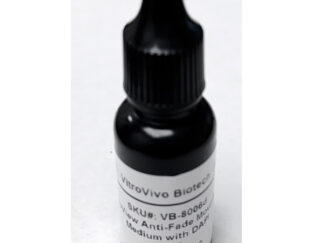
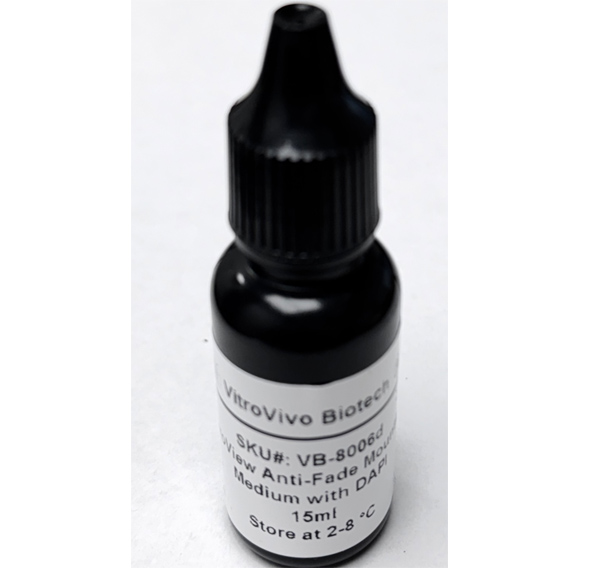
Fluorescence microscopy is a powerful tool in biomedical research, enabling high-resolution visualization of cellular and molecular structures. However, a common challenge in fluorescence imaging is photobleaching, which leads to the rapid fading of fluorophores under prolonged light exposure. To address this issue, VitroView™ Anti-Fade Aqueous Mounting Medium with DAPI provides an advanced solution designed to preserve fluorescence signal integrity while simplifying sample preparation.
This ready-to-use, aqueous mounting medium incorporates anti-fade agents to minimize photobleaching, ensuring long-lasting fluorescence for repeated imaging sessions. Additionally, it contains DAPI (4′,6-diamidino-2-phenylindole), a nuclear counterstain that binds to DNA, allowing for clear visualization of cell nuclei in blue fluorescence. Compatible with a wide range of fluorescent dyes and antibodies, VitroView™ offers excellent specimen protection, minimal background interference, and optimal refractive index for high-resolution microscopy.
Whether used in immunofluorescence (IF) or fluorescence in situ hybridization (FISH), VitroView™ ensures reliable, sharp, and durable fluorescence signals, making it an essential reagent for researchers seeking accurate and reproducible imaging results.
Application
Compatible with AEC, DAB, Oil Red, BCIP/NBT, BCIP/INT and fluorescent dyes and phycobiliproteins.
Package Size
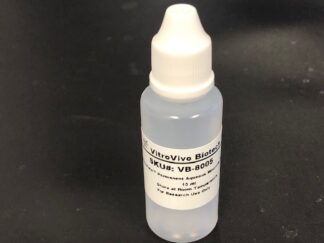
15ml/ squeeze bottle
Storage
Product is stable for about 12 months at 2-8 ºC. .
Usage Instructions
- Place slides flat on paper towel on countertop with specimen facing up.
- Blot excess water from the slide without letting tissue specimen dry prior to mounting.
- Apply 2-3 drops of Aqueous Mounting Medium with DAPI to completely cover the specimen with a thin layer.
Precautions
- Place slides flat on a paper towel on the countertop with the specimen facing up.
- Blot excess water from the slide without letting the tissue specimen dry prior to mounting.
- Apply 2-3 drops of Aqueous Mounting Medium with DAPI to completely cover the specimen with a thin layer.
- Seal coverslip edges with nail polish for long-term storage.
Disclaimer
This user manual serves as a general guideline. Users should adapt procedures based on specific experimental requirements and equipment specifications.